Wednesday, April 10, 2019

NFL Empires: 1929

This is a continuation of my "empire" maps (where victors take the territory of the losers) of the NFL. Different than most such imperialism sports maps, instead of gaining all the loser's land from a victory home or away, the victor only gets territory for an away victory, and just two-thirds of it (or one-third for an away tie).

This is the tenth season of the NFL, starting where the previous season ended and removing Detroit and the Yankees (distributing their land to neighbors based on distance to "capitals"), moving Pottsville to Boston, and adding Buffalo and others (given a 100-mile radius, except only halfway to a "capital" city of the land the new team is taking).

My data was from Pro Football Reference and most of the logos from Sports Ecyclopedia and SportsLogos.net.

Here then is the map of the NFL empires after the 1929 season:

Once again, Dayton (medium blue) held onto their territory by never playing at home. They finished in last place, winless. The victors were Green Bay (green), and their empire matches reality. The Chicago Bears (light blue) had a horrible second half of the season (no wins in their last nine games, including seven at home) and thus fell off the map entirely.

Here is the map before the season started:

Sunday, April 07, 2019

NFL Empires: 1928

This is a continuation of my "empire" maps (where victors take the territory of the losers) of the NFL. Different than most such imperialism sports maps, instead of gaining all the loser's land from a victory home or away, the victor only gets territory for an away victory, and just two-thirds of it (or one-third for an away tie).

This is the ninth season of the NFL, starting where the previous season ended and removing Cleveland and Buffalo (distributing their land to neighbors based on distance to "capitals") and adding Detroit (given a 100-mile radius, except only halfway to a "capital" city of the land the new team is taking).

My data was from Pro Football Reference and most of the logos from Sports Ecyclopedia and SportsLogos.net.

Here then is the map of the NFL empires after the 1928 season:

Green Bay (green) gained quite a bit; newbie Detroit (chartreuse) went gangbusters, and Dayton (medium blue) still holds a lot of land. The official winner of the NFL in 1928? Providence (dark gold). They only had three away games (two wins and a tie), and they were against lowly New York Yankees (red-orange), Frankford (beige), and Pottsville (teal). Dayton never played a home game.

Here is the map before the season started:

Not a good year for Chicago.

Thursday, April 04, 2019

NFL Empires: 1927

This is a continuation of my "empire" maps (where victors take the territory of the losers) of the NFL. Different than most such imperialist sports maps, instead of gaining all the loser's land from a victory home or away, the victor only gets territory for an away victory, and just two-thirds of it (or one-third for an away tie).

This is the eighth season of the NFL, starting where the previous season ended and removing almost half the teams as the NFL kicked out the poorer members, even the ones who had done well on-field (I distributed their land to neighbors based on distance to "capitals"). The Brooklyn Lions (orange) moved to the Bronx and changed their name to the New York Yankees, so they are treated similar to a new team (They get a 100-mile radius, except only halfway to a "capital" city of the land the new team is taking).

My data was from Pro Football Reference and most of the logos from Sports Ecyclopedia and SportsLogos.net.

Here then is the map of the NFL empires after the 1927 season:

Duluth (violet) has a lot of land, but they started the season with even more. Cleveland (grayish green) gained the most territory, but they actually came in fourth place. The New York Giants (dark blue) won officially, but they played more at home than away, including a home loss to Cleveland.

Here is the map before the season started:

Quite a change from the end of 1926! Oh look, the Cardinals had some land.

Monday, April 01, 2019

NFL Empires: 1926

This is a continuation of my "empire" maps (where victors take the territory of the losers) of the NFL. Different than most such imperial sports maps, instead of gaining all the loser's land from a victory home or away, the victor only gets territory for an away victory, and just two-thirds of it (or one-third for an away tie).

This is the seventh season of the NFL, starting where the previous season ended and removing Rock Island and other teams which folded or took a hiatus (distributing their land to neighbors based on distance to "capitals") and adding Los Angeles and other new teams with new territory (taking a 100-mile radius, except only halfway to a "capital" city of the land the new team is taking). There were 22 teams participating in 1926, more than any other season till the NFL-AFL merger.

My data was from Pro Football Reference and most of the logos from Sports Ecyclopedia and SportsLogos.net.

Here then is the map of the NFL empires after the 1926 season:

Kansas City (dark teal) continued its dominance on the map, but their only two home games were against fellow road warriors Duluth (light violet) and Los Angeles (gold), so they never risked much. Kansas City went 8-3, which was good enough for fourth place. Frankford (tan) won the league with a 14-1-2 record, but they only had three road games.

Here is the map before the season started:

Oh look. Hartford was light blue.

Friday, March 29, 2019

NFL Empires: 1925

This is a continuation of my "empire" maps (where victors take the territory of the losers) of the NFL. Different than most such imperial sports maps, instead of gaining all the loser's land from a victory home or away, the victor only gets territory for an away victory, and just two-thirds of it (or one-third for an away tie).

This is the sixth season of the NFL, starting where the previous season ended and removing teams which folded or took a hiatus (distributing their land to neighbors based on distance to "capitals") and adding the New York Giants and other new teams with new territory (taking a 100-mile radius, except only halfway to a "capital" city of the land the new team is taking).

My data was from Pro Football Reference and most of the logos from Sports Ecyclopedia and SportsLogos.net.

Here then is the map of the NFL empires after the 1925 season:

After a dismal first season, Kansas City (dark teal) conquered wide swaths of land this year. But they actually finished 13th out of 20 teams. The official champions were the Chicago Cardinals (magenta), whose only away game was a tie against the cross-town Bears. Hence, not much territory here.

Here is the map before the season started:

Ah, Duluth. At least you have more land than Milwaukee.

Monday, March 25, 2019

NFL Empires: 1924

This continues my "empire" maps (where victors take the territory of the losers) of the NFL. Different than most such imperial sports maps, instead of gaining all the loser's land from a victory home or away, the victor only gets territory for an away victory, and just two-thirds of it (or one-third for an away tie).

This is the fifth season of the NFL, starting where the previous season ended and removing Canton and others which folded or took a hiatus (distributing their land to neighbors based on distance to "capitals") and adding new teams with new territory (taking a 100-mile radius, except only halfway to a "capital" city of the land the new team is taking).

My data was from Pro Football Reference and most of the logos from Sports Ecyclopedia and SportsLogos.net.

Here then is the map of the NFL empires after the 1924 season:

Duluth (violet) look like champions here, but they actually came in fourth. Cleveland (dark sage green) won in real life but barely made a dent on this map. They only played away twice: a draw at Frankford (tan) and a win at Akron (pale green). Meanwhile, Columbus (orange) also gained a lot of land, despite a 4-4 record.

Here is the map before the season started:

Alas, poor Minneapolis.

Friday, March 22, 2019

NFL Empires: 1923

Continuing my "empire" maps (where victors take the territory of the losers) of the NFL. Different than most such imperial maps, instead of gaining all the loser's land from a victory home or away, the victor only gets territory for an away victory, and just two-thirds of it (or one-third for an away tie).

This is the fourth season of the NFL, starting where the previous season ended and removing Evansville which folded (distributing their land to neighbors based on distance to "capitals") and adding new teams with new territory (taking a 100-mile radius, except only halfway to a "capital" city of the land the new team is taking).

My data was from Pro Football Reference and most of the logos from Sports Ecyclopedia and SportsLogos.net.

Here then is the map of the NFL empires after the 1923 season:

Canton (red) conquered more territory and won the official championship for the second year in a row. The Chicago Bears (light blue) came in second again, but they played their last ten games of their thirteen-game season at home, so they lost territory this year. Even the 1-10 Oorang Indians (bright green) gained territory ... by never playing a home game. Meanwhile the 8-4 Chicago Cardinals (magenta) fell off the map entirely by playing only one road game all season (against the Bears).

Here is the map before the season started:

Tuesday, March 19, 2019

NFL Empires: 1922

Continuing my "empire" maps (where victors take the territory of the losers) of the NFL. Different than most, instead of gaining all the loser's land from a victory home or away, the victor only gets territory for an away victory, and just two-thirds of it (or one-third for an away tie).

This is the third season of the NFL (the first when they actually called it the NFL), starting where the previous season ended and removing folded teams (distributing their land to their neighbors based on distance to their "capitals") and adding new teams with new territory (taking a 100-mile radius, except only halfway to a "capital" city of the land the new team is taking).

My data was from Pro Football Reference and most of the logos from Sports Ecyclopedia and SportsLogos.net.

Here then is the map of the NFL empires after the 1922 season:

Canton (red) did well this season and actually won the official championship. The Bears (light blue) came in second, but you can barely tell. They didn't play on the road much at all. The bright green on the west coast (and in the Midwest) was the Oorang Indians, a travelling team composed of Native Americans. They won their one and only home game, so they show much better than a 3-6 record would indicate.

Here is the map at the beginning of 1922:

Friday, March 15, 2019

NFL Empires: 1921

I recently saw "empire" maps for professional and college sports, where victors take the territory of the losers. They seem to usually be reset every year, since they get dominated by a few teams, or just one. But I decided it made more sense that the victor only gets territory for an away victory (and not winning at home), and instead of all the land, just two-thirds (and one-third for an away tie).

I thus decided I had to do this with a long-existing league and start at the very beginning. This then is the second season of the NFL, starting where the first season ended and adding new teams with new territory (taking a 100-mile radius, except only halfway to a "capital" city).

My data was from Pro Football Reference and most of the logos from Sports Ecyclopedia.

Here then is the map of the NFL empires after the 1921 season (when it was called the APFA):

Canton (red) really looks like they did well this season, but the Chicago Staleys (light blue) were crowned champions and Canton were also behind Buffalo (purple) and Akron (pale green). The teams did not play an even number of home and away games, so a team like Canton, who played three home games and seven away games (finishing with six away games), can take territory and never put it at risk by losing. Meanwhile, the Staleys played all eleven games at home (none away!), so they can only lose territory and gain none. It might be good for their trophy case, but it's bad in this empire world.

Here is the map at the beginning of 1921:

Seven of these teams played four or fewer games.

Saturday, March 09, 2019

NFL Empires: 1920

Somewhat late to the game, I recently saw "empire" maps for professional and college sports, where victors take the territory of the losers. They seem to usually be reset every year, since they get dominated by a few teams, or just one. But I decided it made more sense that the victor only gets territory for an away victory (and not winning at home), and instead of all the land, just two-thirds (and one-third for an away tie).

I thus decided I had to do this with a long-existing league and start at the very beginning. I chose the NFL because it has good data and few games. (I got my data from Pro Football Reference and most of the logos from Sports Ecyclopedia.)

Here then is the map of the NFL empires after the 1920 season (when it was called the APFA):

Akron was the official champion that year, and it shows on the map. Since all the teams were crowded in the Midwest, big swaths of land in the West and South changed hands rather quickly.

Here is the map at the beginning of the 1920 season:

Ah, poor Rock Island.

Wednesday, January 16, 2019

US Soccer Combined Leagues 2019

UPDATED December 15, 2019: Final Standings updated based on the teams for next year.

Just suppose that many years ago, the US Soccer Federation required all professional teams to play in the same league system. Just suppose that they decided that it would be best to always have two equal leagues, east and west, and then divide teams vertically into Division 1, Division 2, etc. Just suppose that, each year, they promoted the best teams from Division 2 and relegated the worst teams from Division 1.

And here's the big leap. Just suppose that we didn't have any more teams playing than what we actually have.

In 2019, the USSF has 70 professional men's teams. Only one team (Penn) withdrew after the 2018 season. New teams added to Division 2 West are Austin Bold, El Paso Locomotive, Memphis 901, New Mexico United, North Texas and Tucson. New teams in Division 2 East are Birmingham Legion, Chattanooga Red Wolves, Forward Madison, Greenville Triumph, Hartford Athletic, Lansing Ignite, Loudoun United, Orlando City B and South Georgia Tormenta. Whew! That's quite a lot.

To balance the leagues, Saint Louis and Swope Park Rangers were moved to the West, while Chicago landed in the East.

Here is a map of the teams. Click the rectangle tab thing in the upper left to get to the list where you can deselect the separate divisions.

Here are the final standings for 2019.

Since a wonderful home-and-away round robin didn't actually happen in each league above, I substituted that with ranking the teams by points-per-game, including each team's league and cup games played in 2019, only counting games against teams in its division (Division 1 or 2).

Due to the large number of teams entering play in 2020, a Division 3 will be added. Rather than have three tiers of two leagues, I've decided to have a single 18-team table for Division 1 next year. This will provide competitive balance between East and West, over the years. Thus eight teams will be relegated from each 2019 Division 1 league and ten from each 2019 Division 2 league.

B teams must be in a division below their A teams, so if an A team is relegated from Division 1 to Division 2, then the B team will be relegated to Division 3, no matter its place in the table.

Tuesday, July 10, 2018

European Super League 2018-19

UPDATED May 29, 2019: Final Standings are below.

Some of the the richest clubs of European football have made noise about permanent spots in the UEFA Champions League, or wanting to create a closed European Super League. Naturally, I would prefer an open Super League, with promotion and relegation with the domestic leagues.

Since there are too many "big" clubs for one twenty-team league, I have created a twenty-team Super League and a second division with forty teams, split into East and West Leagues. To pick which teams are placed in which leagues, I used the UEFA Club Coefficients from the end of the 2014-15 season. Since then, each season, two teams were relegated from the Super League to Division 2, replaced by the East and West champions. Two teams from each Division 2 league were relegated, replaced by the four teams that progressed the furthest in the Champions League and Europa League. (Ideally, this would just be the final four Champions League teams, with the relegated teams automatically qualified for the next season's Champions League so they have the potential for promotion as soon as possible).

Bayer 04 Leverkusen and Benfica were relegated from the Super League to Division 2 West. Ajax and Internazionale Milano were promoted to the Super League. Borussia Mönchengladbach, AZ Alkmaar, Sparta Praha, and PAOK were relegated to their respective domestic leagues. Lokomotiv Moskva, RB Leipzig, Salzburg and Ludogorets 1945 were promoted to Divison 2 East.

To keep East and West at 20 teams each, Monaco were moved to the West.

In a change this year, three teams will be relegated from each league. The third Division 2 team promoted will be the second place team with the higher points per game. Ideally, though, this would be a playoff.

Here is a map of the sixty teams in the international leagues. Click the rectangle tab thing in the upper left to get to the list where you can deselect the separate divisions.

Here are the final standings for the 2018-19 season:

The standings include only games against teams in a team's division (Super League or Division 2). The first tiebreaker is the number of games played. The second tiebreaker is the UEFA club coefficient rankings.

The six teams that will be promoted from the domestic leagues are the six teams (that aren't above) who progressed the furthest in the Champions League and Europa League. Since no "new" team advanced to the knock-out round of the Champions League, all six are from the Europa League: Eintracht Frankfurt, Slavia Praha, Krasnodar, Dinamo Zagreb, Stade Rennais, and Celtic (who had the highest coefficient of the teams eliminated in the round of 32, above BATE Borisov, Rapid Wien, Real Betis Balompié, Malmö, and Zürich).

Wednesday, January 17, 2018

US Soccer Combined Leagues 2018

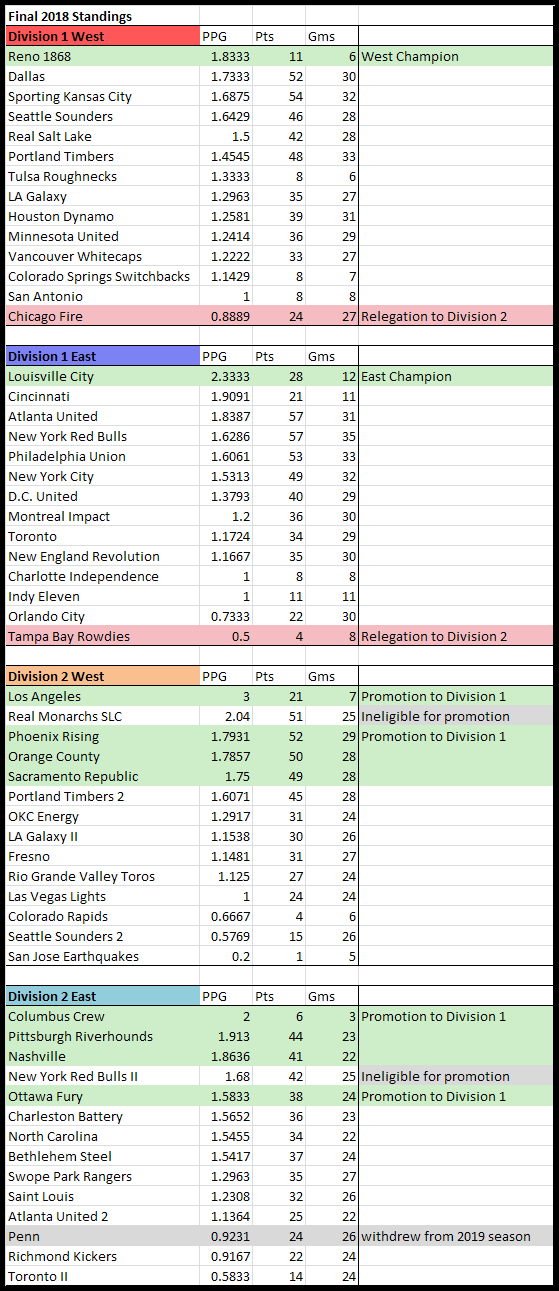
UPDATE 12/8/18: Final standings of the 2018 season.

Just suppose that many years ago, the US Soccer Federation required all professional teams to play in the same league system. Just suppose that they decided that it would be best to always have two equal leagues, east and west, and then divide teams vertically into Division 1, Division 2, etc. Just suppose that, each year, they promoted the best teams from Division 2 and relegated the worst teams from Division 1.

And here's the big leap. Just suppose that we didn't have any more teams playing than what we actually have.

In 2018, the USSF has 56 professional teams. Nine teams folded/withdrew after the 2017 season (Edmonton, Jacksonville Armada, Miami, New York Cosmos, Orlando City B, Puerto Rico, Rochester Rhinos, San Francisco Deltas, and Vancouver Whitecaps 2). New teams added to Division 2 West are Fresno, Las Vegas Lights, and Los Angeles. In the East, the new teams in Division 2 are Atlanta United 2 and Nashville.

To balance the leagues, Saint Louis and Swope Park Rangers were moved from the West to the East.

Here is a map of the teams. Click the rectangle tab thing in the upper left to get to the list where you can deselect the separate divisions.

Here are the current standings:

Since a wonderful home-and-away round robin didn't actually happen in each league above, I have substituted that with ranking the teams by points-per-game, including each team's league and cup games played in 2018, only counting games against teams in its division (Division 1 or 2).

At least one team from each Division 1 league will be relegated and at least one team from each Division 2 league will be promoted. The final number is determined by the number of professional teams in 2019 and the resultant promotions without relegations to even out the divisions. Without adjustments to the number of teams, three would be relegated and three would be promoted. With a current net gain of 13 teams, four are promoted for each team relegated.

B teams in Division 2 are ineligible for promotion as B teams can't be in Division 1.