Showing posts with label science. Show all posts

Friday, February 15, 2008

Mars Couldn't Support Life

According to NASA, Mars once had flowing water on it, but that water was far too salty to have ever supported life. Or at least, it was too salty to support any microbes that we know about.

They found that no known microbes could have survived in the salty and highly acidic waters that once flowed there.

[. . .] But new data from the [O]pportunity rover, which has been wandering the surface of Mars for almost five years, suggests the water that once flowed into the craters and valleys of the planet was far too salty to support most forms of life.

According to NASA, life on Mars would have been very challenging for even the toughest organisms any time over the past four billion years.

From JPL's own article:
Experiments with simulated Martian conditions and computer modeling are helping researchers refine earlier assessments of whether the long-ago conditions in the Meridiani area studied by Opportunity would have been hospitable to microbes. Chances look slimmer. "At first, we focused on acidity, because the environment would have been very acidic," Knoll said. "Now, we also appreciate the high salinity of the water when it left behind the minerals Opportunity found. This tightens the noose on the possibility of life."

So can we go ahead and terraform it now?

Oh, but wait. NASA has more science robots to send first: "The Phoenix lander, on course to reach Mars on May 25, will assess habitability of a shallow subsurface environment of icy soil farther north than any earlier mission has landed."

Are we really going to have to wait until we've researched every last cubic inch of Mars before we start making it fit for human habitation? Too much science! Not enough engineering! C'mon guys. NASA needs to get their priorities realigned.

Wednesday, August 15, 2007

Stop It with the Carbon, Already!

Every time I see or hear something about reducing carbon-dioxide emissions, I feel like bashing my head against a wall. They've got cause and effect completely switched.

Take a can of Coke out of the fridge, open it, and pour the Coke into a glass. Have a drink. Fizzy! Let the rest sit on the counter for a few hours till it warms up to room temperature. Have a drink. Not so fizzy.

What just happened? The Coke warmed up, releasing carbon dioxide (the fizz) into the air. When water is cold, it can hold more carbon dioxide than when it's warm.

The oceans of Earth hold two-thirds of the planet's carbon dioxide, just like a really dilute can of Coke. If something were to warm up the oceans, what do you think would happen to the fizz? Into the air it goes!

The ocean is so big that it takes a few hundred years for the carbon dioxide release to catch up to the warming, but release it, it does.

So, what's warming the oceans? Could it be an increase in solar activity?

What could be causing an increase of airborne carbon dioxide now? Could it be an increase in solar activity several hundred years ago? . . . Nah. That would make too much sense.

Oh, and by the way, plants really love it when they get more carbon dioxide. Farmers often triple the amount of carbon dioxide in their greenhouses to get the plants to grow better. Curiously, that tripled level of carbon dioxide approximates the conditions during the age of dinosaurs. They had giant plants back then, too, didn't they?

The Future of Mankind

If humanity survives the next seventeen mass extinctions, we'll live long enough to see all the water vapor in the atmosphere boil away into space due to an overheating sun. Hopefully we'll have spread to other planets by then.

1.1 billion years is a long time, especially for a species that's only been around 0.0002 billion years. I'm sure we'll work something out by then.

Mass Extinctions Explained

We're living in a period of mass extinction that started within the past million years and will last five to thirty more million years. Away went the mastadon and the dodo, the moa and the sabertooth cat, but which species will die out next? It's possible that only 20% of genera will die out, but perhaps 95% will.

Will human beings be part of the survivors? I think so, but maybe the gorillas won't make it. Come back in thirty million years and ask me again.

Most mass extinctions are tied to the wobble of the solar system as we orbit the center of the Milky Way. Due to various gravitational effects, we regularly bob up and down like a horse on a carousel. From one high point to the next high point is approximately 64 million years (+/- 3 million).

As we pass through the galactic plane from the southern side to the northern side, we become subject to more cosmic radiation since the northern side is the "front" of the Milky Way as it travels through intergalactic space. Being on the northern side of the galaxy is like sitting on the front bumper of a pickup truck: you get hit by a lot more bugs than if you're in the bed behind the cab.

It is theorized that those cosmic radiation "bugs" cause bad things (cancer, mutations, clouds, etc.) which cause species to die out.

Some extinctions last only a few million years during the transition from the back of the galaxy to the front, but some last the entire 32 million years the Earth is on the front of the galactic pickup truck.

Right now, we passed through the galactic plane, south to north, within the past three million years. Thus, a mass extinction is beginning. How long it will last, no one knows. But let's get that cure for cancer before it's too late.

Tuesday, August 14, 2007

It's not as hot as you think it's been.

You probably already know this, but we have some shady characters in our government's employ.

NASA revised their temperature data last week to reflect a Y2K bug found in their calculations. 1998 is no longer the warmest year in America's past century. That honor has been returned to 1934. Not that a look at NASA's website would enlighten you to this fact. There are no press releases. Nothing in any of their articles reflects this change. They just quietly changed the data after someone pointed out an error in their temperature calculations.

"Calculations?" you ask. "What calculations?" Apparently our public officials have been doing alchemy on the measured data to "fix" it for heat-island effect and other such things. No one outside NASA GISS knows what their calculations are, because they refuse to let anyone else see them.

The Y2K bug meant that from year 2000-2007, they calculated the heat-island effect as if the cities were of a density from 1900-1907. It's as if they thought someone tore up all the concrete and asphalt from all the cities.

How does this affect 1998? Why, because of further hocus pocus, of course. The official numbers are actually a five-year average!

This doesn't explain all the "adjustments" to their data. There's problems like air conditioners being install next to thermometers. They also fiddle with data from natural-setting thermometers to fit urban thermometers, which are notoriously less reliable. And they've certainly increased the reported temperatures over the past few decades a lot more than they ever did before.

A good quote from the last link, CoyoteBlog, which explains what's going on here: "Temperatures that don't increase as they expect are treated as an error to be corrected, rather than a measurement that disputes their hypothesis."

In summation, the so-called scientists fiddle with any data that gets in the way of their next global-warming-hysteria-provided paycheck.

Tuesday, April 24, 2007

Real Kryptonite Isn't Green

Miners in Serbia discovered a mineral that, upon inspection by scientists, has almost the exact same composition as kryptonite, as described in the movie Superman Returns: a hydroxide of sodium lithium boron silicate.

The only problem: it isn't green and glowy. It's chalky white.

And they can't call it kryptonite, because it doesn't have any krypton in it. So they'll name it jadarite, after the region where it was found.

Can you imagine Superman cowering in fear from a pile of chalk dust? It doesn't quite have the same artistic oomph.

Apparently, the only difference is that the real rock doesn't have fluorine in it. Would adding fluorine make it green and glowy? And would it give humans weird superpowers?

Thursday, April 12, 2007

How Good Is Your Eyesight?

If large-print magazines are for elderly people, how young do you have to be to read this book?

Canadian researchers say they have produced the world's smallest published book, a story of a turnip contest that will require readers to use an electron microscope.

The book, entitled Teeny Ted from Turnip Town, measures 0.07 mm by 0.10 mm and was made using a focused gallium-ion beam to carve out spaces around each letter on pieces of crystalline silicon, according to Simon Fraser University.

70µm by 100 µm. That's teeny, all right!

Wednesday, April 04, 2007

Scientific Consensus of the Non-Scientists

I happened across an article from last July at LiveScience.com that presents twelve viewpoints on "Global Warming."

The interviewed individuals include several professors, some scientists, and a former vice-president. As I read, I discovered that the individuals with climate science backgrounds tended to have differing opinions about "Global Warming" than, say, the psychology professor.

Here is a list of their qualifications, in order of believability based on background:

1. Hurricane expert and Head of the Tropical Meteorology Project at Colorado State University.
2. Professor of meteorology at Massachusetts Institute of Technology.
3. Professor emeritus at Institute for Advanced Studies, Princeton University.
4. Professor of Natural Resources, Virginia Tech, State Climatologist for Virginia.
5. Director of NASA's Goddard Institute for Space Studies.
6. Professor in the Department of the Geophysical Sciences from the University of Chicago.
7. Associate director of the Center for Health and the Global Environment at Harvard Medical School.
8. Professor of geography at the University of California in Berkeley.
9. Associate professor of history and Director of the Program in Science Studies at the University of California, San Diego.
10. Senior research scientist, Harvard School of Public Health, Harvard University.
11. Former vice-president.
12. Professor of psychology at Harvard University.

1. The hurricane expert has been studying this stuff for decades. He's extremely skeptical of those who say humans are causing global warming. His main point is that the world heats and cools and heats and cools and it's natural.

2. The meteorology professor bashes the press and politicians for alarmism and for trying to justify costly Enviromentalist policies.

3. The professor emeretius says that climate change is partly caused by humans, but "its importance has been grossly exaggerated," and then he goes on to complain about all the other ills of civilization that are being ignored.

Skip down to #9, the history professor: "Many people have the impresson that there is significant scientific disagreement about global climate change. It's time to lay that misapprehension to rest." After reading the words of the above three scientists, you'd think he would be agreeing with them, but no. He continues, "We need to stop repeating nonsense about the uncertainty of global warming and start talking seriously about the right approach to address it."

You gotta believe him. After all, he's a professor of history.

I won't even bother to mention what the politician and psychologist say. I'm sure you can guess.

Wednesday, November 29, 2006

I think they're just making it up

For the past few hours, weather.com's radar map has shown snow falling in north Seattle. But I look out the window (and walk to lunch and back) and see nary a flake in the air.

The current map shows rain/snow mix for Auburn southward because I guess that's where they think the 32-degree line is. But if it's not snowing here, is it really raining/snowing there? Are they just guessing? I think they're just making it up.

Tuesday, November 07, 2006

We're all gonna die!!

Does anybody remember all those hurricanes we had this year? I know the season officially doesn't end till November 30 and last year we had storms form in December, but let's take a look at the comparison between predictions and reality.

From Wikipedia:

Average # of named storms: 9.6
Average # of hurricanes: 5.9
Average # of major hurricanes: 2.3

Predicted # of named storms: 17
Predicted # of hurricanes: 9
Predicted # of major hurricanes: 5

Actual # of named storms: 9
Actual # of hurricanes: 5
Actual # of major hurricanes: 2

So, um. . . Back to the average. The world is not ending.

Global Warming Data

Here's why I don't trust scientists: They're human and have agendas and are willing to bend the truth to fit their agenda.

There's an article in the Sunday Telegraph describing just how the scientists and bureaucrats of the UN massacred the global warming data to create a global panic.

You probably are familiar with the hockey-stick graph of worldwide temperatures, where the temperature goes up and down, more or less level, then abruptly shoots up in the twentieth century.


The top graph is from the UN's report of 2001. The bottom graph is from the UN's report of 1996. Notice anything different? Well, here's how they got from one to the other:

• They gave one technique for reconstructing pre-thermometer temperature 390 times more weight than any other (but didn't say so).

• The technique they overweighted was one which the UN's 1996 report had said was unsafe: measurement of tree-rings from bristlecone pines. Tree-rings are wider in warmer years, but pine-rings are also wider when there's more carbon dioxide in the air: it's plant food. This carbon dioxide fertilisation distorts the calculations.

• They said they had included 24 data sets going back to 1400. Without saying so, they left out the set showing the medieval warm period, tucking it into a folder marked "Censored Data".

• They used a computer model to draw the graph from the data, but scientists later found that the model almost always drew hockey-sticks even if they fed in random, electronic "red noise".

That all sounds scientifically honest, now doesn't it?

There's more. The sun heats and cools in cycles. It's currently in a very hot period. I won't bore you with the numbers (they're in the link), but here's a summation: "The entire 20th-century warming from all sources was below 2 watts. The sun could have caused just about all of it."

And they've also messed with the laws of thermodynamics. Has anyone heard of the Stefan-Boltzmann law? Well, apparently there's a little lambda in that equation that equals hc/ukT. A simple version of the equation is E=(sigma)T^4. The lambda is partially in the sigma, I guess. In any case, T is temperature. If you know the temperature and size of a body, you know how much it's radiating, and lambda to boot.

(In case you cared, Boltzmann is the Austrian who committed suicide because nobody believed him when he said that atoms existed.)

So the centuries-old method of calculating lambda gives you 0.2-0.3 deg C/watt. Guess what the UN's computer models use? 1.0 deg C/watt. Why? Because it fits their agenda better. Some "scientists" have used 1.9 deg C/watt just to scare you better.

And here are the concluding lines from the article, just because I can't say them better:

Removing the UN's solecisms, and using reasonable data and assumptions, a simple global model shows that temperature will rise by just 0.1 to 1.4C in the coming century, with a best estimate of 0.6C, well within the medieval temperature range and only a fifth of the UN's new, central projection.

Why haven't air or sea temperatures turned out as the UN's models predicted? Because the science is bad, the "consensus" is wrong, and Herr Professor Ludwig Boltzmann, FRS, was as right about energy-to-temperature as he was about atoms.

And no matter how much power we give to the UN and how much we destroy our economy with crippling regulations, we are not going to reverse the trends of nature.

Friday, October 06, 2006

IgNobels Announced!

The IgNobels are alternative prizes for scientists whose research isn't deemed serious enough for the Nobel committee, but still is pretty interesting stuff. This year's winners include:

Two Australian researchers from the Commonwealth Scientific and Research Organisation (CSIRO) have won an IgNobel for their research on how many photos you need to take to ensure that nobody in a group photo has their eyes closed.

Ivan Schwab, of the University of California Davis, and the late Philip May, of the University of California Los Angeles, have won the ornithology prize for their pioneering work on the ability of the humble woodpecker to avoid head injury.

Wasmia Al-Houty, of Kuwait University, and Faten Al-Mussalam, of the Kuwait Environment Public Authority, have taken home the nutrition prize for showing that dung beetles are in fact finicky eaters.

Francis Fesmire, of the University of Tennessee, has been awarded the medicine Ig for his report Termination of Intractable Hiccups with Digital Rectal Massage.

Physics laureates Basile Audoly and Sebastien Neukirch of Paris University are to be honoured for their insights into why dry spaghetti tends to break into more than two pieces.

Howard Stapleton of Merthyr Tydfil, Wales, has been awarded the peace prize for inventing an electromechanical teenager repellent. The device makes an annoying noise designed to be audible to teenagers but not to adults. He later used the same technology to make telephone ringtones that are audible to teenagers but not to their teachers.

Three US scientists - Lynn Halpern, Randolph Blake and James Hillenbrand - have been awarded the acoustics prize for conducting experiments to learn why people dislike the sound of fingernails scraping on a blackboard.

While the conclusions of a group of scientists from Valencia University and the University of Illes Balears in Spain are not immediately clear, the judges have deemed their study Ultrasonic Velocity in Cheddar Cheese as Affected by Temperature worthy of the chemistry prize.

Also honoured for cheese research, Bart Knols from Wageningen Agricultural University in the Netherlands has won the biology award for his part in research showing that female malaria mosquito are equally attracted to limburger cheese and human feet.
The scientists take this award seriously nowadays, with 8 of this year's 10 recipients flying to Cambridge, Massachusetts, for the ceremony.

Monday, September 25, 2006

Time of the Season

Is it just me, or has anyone else noticed that the tree leaves are reflecting significantly lower electromagnetic frequencies than they were just a week ago?

Monday, August 28, 2006

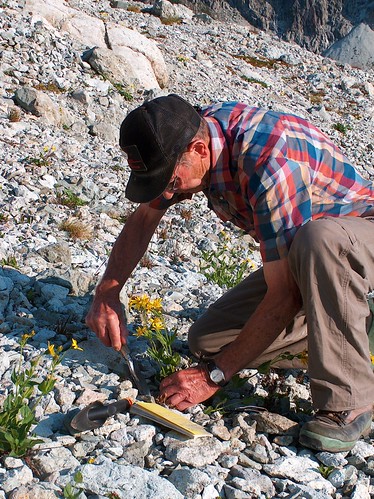
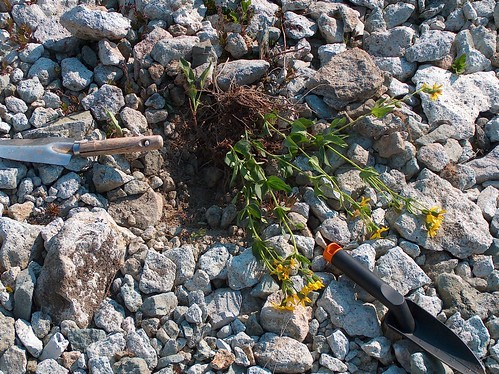
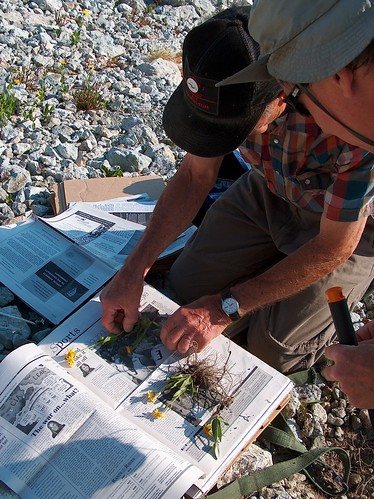
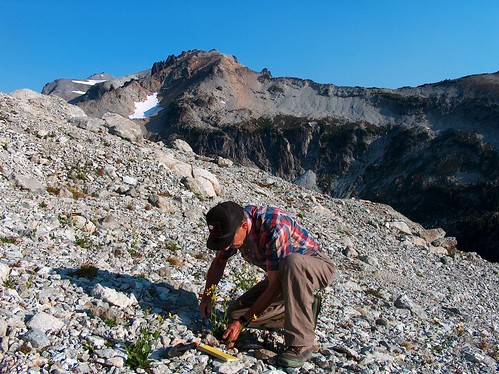
The Saga of the Little Yellow Flower

39-DanielGranddadArnica
40-GranddadArnica
41-Arnica
42-GranddadDadArnicaPlantPress
And thus the Arnica Whatchimacalia will be preserved for eternity at the University of Washington Botany Department.

Tuesday, August 22, 2006

Can o' Worms

As I'm sure you all know, the sixteen most massive objects in the solar system are:

Sun
Jupiter
Saturn
Neptune
Uranus
Earth
Venus
Mars
Mercury
Ganymede
Titan
Callisto
Io
Moon
Europa
Triton

"Xena" probably comes next, but its mass hasn't been pinned down yet. And then Pluto. And then "Santa" and "Easterbunny," most likely, followed by Titania, Oberon, and Sedna.

Note that I haven't said Charon or Ceres yet, which are the two objects the IAU listed right beside "Xena" in their definitely-planets-if-we-make-this-rule declaration. In fact, Charon is about half the mass of Sedna, and Ceres is less than a third the mass of Sedna. So why aren't Sedna, "Santa," and "Easterbunny" on the definitely-planets-if-we-make-this-rule list?

But then we run into another problem with the IAU's planet definition. They also state that the object should be almost spherical. This leaves off all but a couple asteriods (Ceres and Vesta). All asteroids ranked third and below are irregularly shaped.

But remember "Santa"? It's next in line behind Pluto and almost three times as massive as Charon (over four times as big as Ceres). But it's irregularly shaped. It's almost 2000 km long by less than 1000 wide. So is it a planet? Would the IAU really leave it off the list just because it's oblong?

. . . What would it be like to stand on such a planetoid as "Santa"? It would be as if the entire world were two huge mountains, with only a few level locations on the entire surface. At the top of the mountains (the ends of the long axis), the gravity would be 0.29 m/s2. At the bottom of the valley (the ends of the shortest axis), the gravity would be 1.1 m/s2. (Earth surface gravity is 9.8 m/s2.) You'd weigh over three times as much at the bottom than at the top! In fact, gravity at the low point would be almost twice as much as on Pluto, a more massive planet. Weird, huh?

Hm. "Santa" is oblong because it rotates so fast, they say. Its rotational period is 3.915 hours. Would you even be able to stand on top one of the mountains if it is spinning so fast? What's the escape velocity? 0.84 km/s. And at the top of the mountain, you'd be going 0.43 km/s standing still. So. . . you'd have to travel an extra 1452 km/h. Oh good.

Saturday, July 22, 2006

Hot enough for ya?

Even the most temperate corners of the kingdom are having incredibly high temperatures. And you know why? It's because today is the Holy Day of Zhoro, the God of Heat!

So He's just doing His thing, nothing to worry about.

Except the metric system, of course.

When it gets really hot, the Fahrenheit thermometer shows 100°. When it gets really cold, the Fahrenheit thermometer shows 0°. But the Celsius thermometer shows 38° and -18°, respectively. How silly is that? Not nearly so useful for day-to-day applications.

Tuesday, June 20, 2006

Space News

Earth Surrounded by Giant Fizzy Bubbles!

You think it's a joke, don't you?

Wednesday, May 31, 2006

Eight Blind Scorpions

Well, they're not all scorpions, but they're all blind. A quarry in Israel uncovered a cave which had apparently been sealed off for millions of years (or so the scientists say). The scientists found eight previously undiscovered species of invertebrates, some crustaceans and some scorpions.

But, since none of them had seen the light of day for millions of years, they have no eyes. Just another useless appendage that got ignored during breeding. Or maybe the blind ones coped better in the darkness than the sighted ones and thus had more children.

I bet if they start breeding these species in daylight, eventually sight would return. The code is in the DNA. It just needs to be retrieved.

Saturday, May 20, 2006

144-oz Schoolgirl

In Thailand, there is a father who is convinced that his eight-year-old daughter weighs only nine pounds. Every day of her life, he's weighed her with the same scale and it's always read the same, so obviously she never gained an ounce. He takes the scale everywhere they go, just to prove his claim.

So, because he believes his measurements over common sense, does that mean he's a scientist? (-;

Monday, May 01, 2006

New Scientific Finding

Dark chocolate helps sore muscles heal.