Flag of Montana
Too many US states have a state seal or something similar centered on a blue flag. Montana's flag has a colorful seal, so I'd just expand those colors to the entire flag and keep the tools.
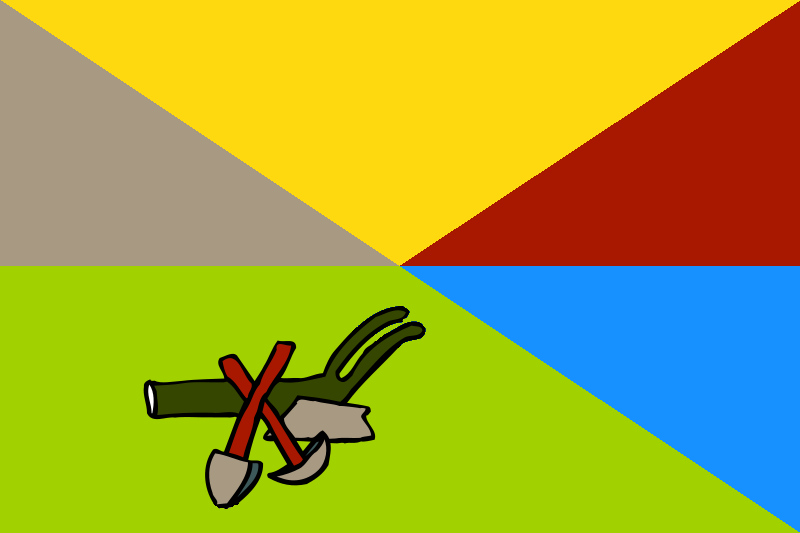

Too many US states have a state seal or something similar centered on a blue flag. Montana's flag has a colorful seal, so I'd just expand those colors to the entire flag and keep the tools.
Too many US states have a state seal or something similar centered on a blue flag. For Utah, I would base the flag on the shield in the center of the seal. To keep from changing a "symbol on a blue sheet" flag to a "symbol on a white sheet" flag, I've added a thick gold trim taken from the shield's edge.


Too many US states have a state seal or something similar centered on a blue flag. For Idaho, I propose a flag based on the design of the shield in the center of the seal. Mountains, river, tree. Simple.


Too many US states have a state seal or something similar centered on a blue flag. Currently Oregon's flag has a different image on the front and back. I propose to take the beaver from the back, enlarge it, and put it on both sides. It would still be an emblem on a blue flag, but at least it would be recognizable.


UPDATED February 1, 2022: Final standings.
Just suppose that many years ago, the US Soccer Federation required all professional teams to play in the same league system. Just suppose that they decided to divide teams vertically into Division 1, Division 2, etc. Just suppose that, each year, they promoted the best teams from Division 2 and relegated the worst teams from Division 1.
And here's the big leap. Just suppose that we didn't have any more teams playing than what we actually have.
In 2021, the USSF has 79 professional men's teams. After the 2020 season, Reno 1868, Saint Louis, Portland Timbers 2, Orlando City B, and Philadelphia Union II folded. New teams added to Division 3 East are Maryland Bobcats and New Amsterdam, while Austin FC is added to Division 3 West.
Here is a map of the teams. Click the rectangle tab thing in the upper left to get to the list where you can deselect the separate divisions.

Since a wonderful home-and-away round robin doesn't actually happen in each league above, I substitute that with ranking the teams by points-per-game, including each team's league and cup games played in 2021, only counting games against teams in its division (Division 1, 2 or 3).
Four teams will be relegated from Division 1, while the best two of each Division 2 league will be promoted.
Due to the large number of new teams added in 2022, a Division 4 will be added. In conjunction with this, Division 2 will reduce to one league. One team will be promoted from each Division 3 league.
B teams must be in a division below their A teams (unless both are in Division 3), so if an A team is relegated from Division 1 to Division 2, then the B team will be relegated from Division 2 to Division 3, no matter its place in the table. Fort Lauderdale is Inter Miami's B team, so Fort Lauderdale will be relegated if Inter Miami isn't promoted.
UPDATED May 29: Final Standings for the season.
Some of the the richest clubs of European football have made noise about permanent spots in the UEFA Champions League, or wanting to create a closed European Super League. Naturally, I would prefer an open Super League, with promotion and relegation with the domestic leagues.
Since there are too many "big" clubs for one twenty-team league, I created a twenty-team Super League and a second division with forty teams, split into East and West Leagues. To pick which teams are placed in which leagues, I used the UEFA Club Coefficients from the end of the 2014-15 season. Since then, each season, teams were relegated from the Super League to Division 2, replaced by the East and West champions. Beginning with the 2018-19 season, the second-place team with the better record was also promoted to the Super League. (Ideally a playoff.) Three teams from each Division 2 league are relegated, replaced by the six teams that progress the furthest in the Champions League and Europa League. (Ideally, this would just be the final Champions League teams, with the relegated teams automatically qualified for the next season's Champions League so they have the potential for promotion as soon as possible.)
After the previous season, Porto and Genk were relegated from the Super League to Division 2 West. Dynamo Kyiv were relegated from the Super League to Division League East. Celtic, Olympiacos and Slavia Praha were promoted from Division 2 to the Super League. Gent, Sporting Portuga, Anderlecht, Fenerbahçe, Rubin and Viktoria Plzeň were relegated to their respective domestic leagues. Basel 1893 and Woverhampton Wanderers were promoted to Division 2 West. Atalanta, Copenhagen, Wolfsburg and İstanbul Başakşehir were promoted to Division 2 East.
Here is a map of the sixty teams in the international leagues. Click the rectangle tab thing in the upper left to get to the list where you can deselect the separate divisions.
Below are the final standings.

The standings include only games against teams in a team's division (Super League or Division 2). The first tiebreaker is the number of games played. The second tiebreaker is the UEFA club coefficient rankings.
The six teams that will be promoted from the domestic leagues for the 2021-22 season are the six teams (that aren't in these international leagues) who progress the furthest in the Champions League and Europa League: Borussia Mönchengladbach, Granada, Molde, Rangers, Young Boys, and Crvena zvezda (per highest club coefficient of the teams that ended in the round of 32).
UPDATED February 2, 2021: Final Standings edited for who's playing in 2021.
Just suppose that many years ago, the US Soccer Federation required all professional teams to play in the same league system. Just suppose that they decided to divide teams vertically into Division 1, Division 2, etc. Just suppose that, each year, they promoted the best teams from Division 2 and relegated the worst teams from Division 1.
And here's the big leap. Just suppose that we didn't have any more teams playing than what we actually have.
In 2020, the USSF has 81 professional men's teams. After the 2019 season, Fresno and Lansing United folded, while the Ottawa Fury moved to Miami to become The Miami FC. Since there are now too many teams for two divisions with two leagues each, a Division 3 was created. New teams added to Division 3 West are 1904, California United Strikers, Los Angeles Force, Oakland Roots, San Diego Loyal and Union Omaha. New teams in Division 3 east are Chattanooga FC, Detroit City, Inter Miami and their B team Fort Lauderdale, Michigan Stars, New England Revolution II and Stumptown Athletic.
Here is a map of the teams. Click the rectangle tab thing in the upper left to get to the list where you can deselect the separate divisions.

Since a wonderful home-and-away round robin doesn't actually happen in each league above, I substitute that with ranking the teams by points-per-game, including each team's league and cup games played in 2020, only counting games against teams in its division (Division 1, 2 or 3).
Four teams will be relegated from Division 1, while the best two of each Division 2 league will be promoted. Three teams will be relegated from each Division 2 league and three promoted from each Division 3 league. If there are more new teams for next year, this may be adjusted. At least one team from each Division 2 league will be relegated no matter how many teams are added next year.
B teams must be in a division below their A teams (unless both are in Division 3), so if an A team is relegated from Division 1 to Division 2, then the B team will be relegated to Division 3, no matter its place in the table. Fort Lauderdale is Inter Miami's B team, so Inter Miami would be promoted in their place if Fort Lauderdale ended the season in a promotion position.
This is a continuation of my "empire" maps (where victors take the territory of the losers) of the NFL. Different than most such imperialism sports maps, instead of gaining all the loser's land from a victory home or away, the victor only gets territory for an away victory, and just two-thirds of it (or one-third for an away tie).
1970 was the first season after the NFL-AFL merger was completed. Pittsburgh, Baltimore, and Cleveland moved to the AFC and the rest is history.
Since the Super Bowl was played at a neutral site, the winner gains one third of the territory of the loser (splitting the difference between a home game and an away game).
My data was from Pro Football Reference and most of the logos from SportsLogos.net.
Here then is the map of the NFL empires after the 1970 season:

Baltimore (royal blue) beat Dallas (gray green) in the Super Bowl, which is how Baltimore gained most of their land on this map. They had a great season (and thus home-field advantage during the playoffs) but they didn't beat any big empires till Dallas. In the NFC, Minnesota (dark violet) had home-field advantage, but they lost to San Francisco (burgundy), who then lost at home to Dallas in the conference championship. Thus no empire dominates the map.
Los Angeles (red), Kansas City (light violet), St. Louis (magenta), and New York (dark blue) all had respectable empires (by this year's standards), but all missed the playoffs by a game or two. Kansas City lost at home to Dallas, plus two home ties, to see their empire crumble. Detroit (gray purple) made the playoffs as a wildcard, but promptly lost in Dallas.
Here is the map before the season started:

So much for purple.
This is a continuation of my "empire" maps (where victors take the territory of the losers) of the NFL. Different than most such imperialism sports maps, instead of gaining all the loser's land from a victory home or away, the victor only gets territory for an away victory, and just two-thirds of it (or one-third for an away tie).
There were no changes to the teams before the seasons.
Since the Super Bowl was played at a neutral site, the winner gains one third of the territory of the loser (splitting the difference between a home game and an away game).
My data was from Pro Football Reference and most of the logos from SportsLogos.net.
Here then is the map of the NFL empires after the 1969 season:

Purple power! Kansas City (light violet) of the AFL beat Minnesota (dark violet) in the Super Bowl, thus expanding their already-large empire. Kansas City had been second place in the AFL West, behind Oakland (light green yellow), but Kansas City beat the New York Jets (dark turquoise) then Oakland in the playoffs, in each of their home stadiums.
In the NFL, Minnesota took all their land during the regular season, then had home-field advantage in the playoffs. Baltimore (royal blue) still had a large remnant of the empire they began the year with, but they only came in second place in the Coastal Division, behind Los Angeles (red). Cleveland (brown) also lost land this year, despite a road playoff victory over Dallas (gray green). To round out the purple on the map, Detroit (gray purple) came in second in the Central, behind Minnesota, and thus weren't in the playoffs.
Here is the map before the season started:

Quite the difference, eh?
This is a continuation of my "empire" maps (where victors take the territory of the losers) of the NFL. Different than most such imperialism sports maps, instead of gaining all the loser's land from a victory home or away, the victor only gets territory for an away victory, and just two-thirds of it (or one-third for an away tie).
Before the season, Cincinnati was added. I've given them the land within a 100-mile radius to start.
Since the Super Bowl was played at a neutral site, the winner gains one third of the territory of the loser (splitting the difference between a home game and an away game).
My data was from Pro Football Reference and most of the logos from SportsLogos.net.
Here then is the map of the NFL empires after the 1968 season:

The New York Jets (dark turquoise) beat Baltimore (royal blue) in the Super Bowl, the first AFL victory over the NFL. The Jets thus were the first AFL team with a large empire on this map, including four capitals besides their own. Baltimore were undefeated at home, with plenty of road wins to amass a huge empire, even after losing a third of it to the Jets. Oakland (light green yellow) won the AFL West, but still didn't have much land to show for it.
Cleveland (brown) won the Century Division and amassed a significant chunk of land, despite losing the NFL Championship Game at home to Baltimore. Green Bay (kelly green) came in third place in the four-team Central Division, but are prominent on the map thanks to a last-week victory at Chicago (periwinkle).
Here is the map before the season started:

Hot map; cool map.
This is a continuation of my "empire" maps (where victors take the territory of the losers) of the NFL. Different than most such imperialism sports maps, instead of gaining all the loser's land from a victory home or away, the victor only gets territory for an away victory, and just two-thirds of it (or one-third for an away tie).
Before the season, New Orleans was added. I've given them the land within a 100-mile radius to start.
Since the AFL-NFL World Championship Game was played at a neutral site, the winner gains one third of the territory of the loser (splitting the difference between a home game and an away game).
My data was from Pro Football Reference and most of the logos from SportsLogos.net.
Here then is the map of the NFL empires after the 1967 season:

Green Bay (kelly green) had a bad season, including a loss to Pittsburgh (yellow) the final week of the season, but they still won the AFL-NFL World Championship Game. Pittsburgh was last place in the Century Division. Los Angeles (red) and Baltimore (royal blue) were first and second in the Coastal Division, both with large empires. Dallas (gray green) and Cleveland (brown) won their divisions, but neither amassed much of an empire.
In the AFL, Oakland (light green yellow) beat Houston (dark green yellow) in the championship game for the right to lose to Green Bay. Despite that final loss, Oakland still managed to have the largest empire of the AFL teams.
Here is the map before the season started:

New Orleans did all right for an expansion team, eh?
This is a continuation of my "empire" maps (where victors take the territory of the losers) of the NFL. Different than most such imperialism sports maps, instead of gaining all the loser's land from a victory home or away, the victor only gets territory for an away victory, and just two-thirds of it (or one-third for an away tie).
In 1966, the NFL officially merged with the AFL. The two leagues kept their names and independent schedules, but met at the end of the season in the AFL-NFL World Championship Game, later dubbed the Super Bowl. Thus Oakland, San Diego, Denver, Kansas City, Houston, Miami, Buffalo, the New York Jets, and Boston entered the league. Also joining the league, but on the NFL side, was Atlanta. As new teams in the greater NFL, all the teams were given the land within 100 miles of their capitals, except for land controlled by a nearer capital.
Since the AFL-NFL World Championship Game was played at a neutral site, the winner gains one third of the territory of the loser (splitting the difference between a home game and an away game).
My data was from Pro Football Reference and most of the logos from SportsLogos.net and Sports Ecyclopedia.
Here then is the map of the NFL empires after the 1966 season:

Green Bay (kelly green) beat Kansas City (light violet) in the AFL-NFL World Championship Game. Since the AFL didn't have much land to start with, Green Bay only gained minimal land from the game, around Kansas City and Houston. In the preceding NFL championship game, Green Bay beat Dallas (gray green) in Dallas, but not much land changed hands that game either. Dallas had lost to Eastern fifth-place Washington (gold) in the next-to-last game of the season, and Washington lost to third-place Philadelphia (dark green) in the last week, so the land Dallas had amassed during the season got divvied up by the end. In the AFL championship game, Kansas City beat Buffalo (denim blue) in Buffalo, which is where Green Bay's new Houston lands came from.
Meanwhile, NFL Western second-place Baltimore (royal blue) expanded their empire nicely, although Eastern second-place Cleveland (brown) didn't. Surprisingly, Western last-place Minnesota (dark violet) managed to hold onto a decent empire, thanks to a mid-season victory at Green Bay and a late win at Detroit (gray purple).
Here is the map before the season started:

100 miles doesn't go very far in southern California, does it?
Sotosoroto King, husband, architect, etc. etc. etc. |

|

California Roadtrip, Summer 2006

Light Rail Neighborhood Density
The World Does Not Agree with You
Failure Should Never Be Rewarded
Thoughts on Illegal Immigration
I'm a Native American, Dammit!
More "Global Warming" Skepticism
Giant Solar System Model along I-90
Restaurant at the End of the Universe Movie Idea