Sunday, June 30, 2019

NFL Empires: 1955

This is a continuation of my "empire" maps (where victors take the territory of the losers) of the NFL. Different than most such imperialism sports maps, instead of gaining all the loser's land from a victory home or away, the victor only gets territory for an away victory, and just two-thirds of it (or one-third for an away tie).

There were no changes from the 1954 season.

My data was from Pro Football Reference and most of the logos from SportsLogos.net and Sports Ecyclopedia.

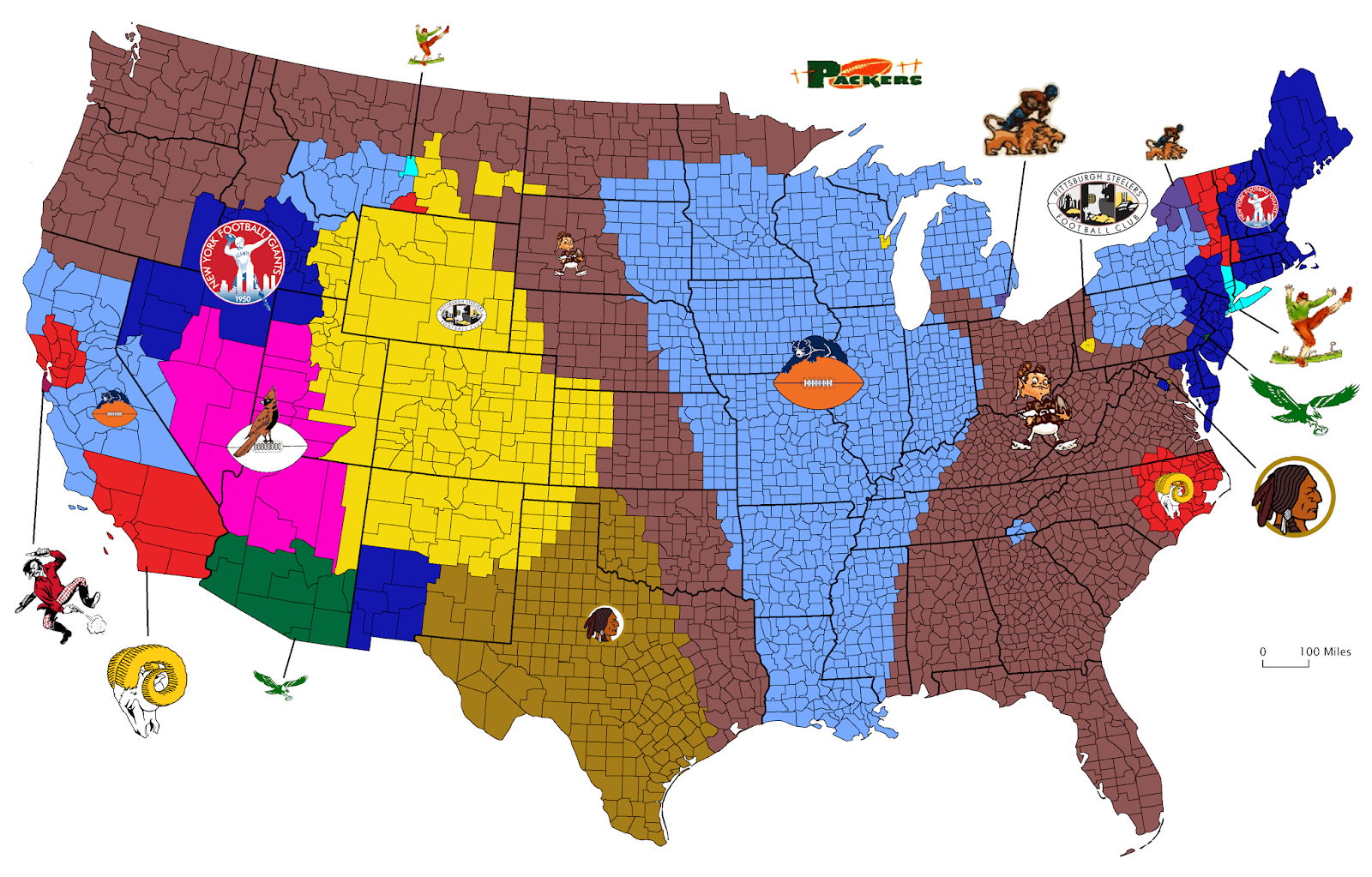
Here then is the map of the NFL empires after the 1955 season:

Cleveland (brown) beat Los Angeles (red) in the championship game in Los Angeles, gaining wide swaths of land in the process, mostly in the east, courtesy of a late Los Angeles victory over Philadelphia (dark green). Washington (gold) came in second in the East, but barely made any progress on the empire front. The Chicago Bears (light blue) came in second in the West, amassing a large central empire where last-place Detroit (purple) had once ruled.

Here is the map before the season started:

Oh look! Even the Cardinals got some land!

Thursday, June 27, 2019

NFL Empires: 1954

This is a continuation of my "empire" maps (where victors take the territory of the losers) of the NFL. Different than most such imperialism sports maps, instead of gaining all the loser's land from a victory home or away, the victor only gets territory for an away victory, and just two-thirds of it (or one-third for an away tie).

There were no changes from the 1953 season.

My data was from Pro Football Reference and most of the logos from SportsLogos.net and Sports Ecyclopedia.

Here then is the map of the NFL empires after the 1954 season:

Cleveland (brown) won the championship game at home over Detroit (purple), with a final score of 56-10. A week earlier, however, Detroit beat Cleveland in the same stadium, 14-10, to take most of their land. Two weeks before that, Detroit hosted Philadelphia (dark green) and they tied. Philadelphia came in second in the East, while spreading their empire over almost all the eastern lands. Second place in the West were the Chicago Bears (light blue), who didn't even manage to conquer Chicago.

Here is the map before the season started:

The West Coast teams didn't fare too well this season.

Monday, June 24, 2019

NFL Empires: 1953

This is a continuation of my "empire" maps (where victors take the territory of the losers) of the NFL. Different than most such imperialism sports maps, instead of gaining all the loser's land from a victory home or away, the victor only gets territory for an away victory, and just two-thirds of it (or one-third for an away tie).

Before the season, Dallas folded. They had no land anyway. Also, Baltimore got a new team, and with it, the land within 100 miles except the land controlled by a nearer capital.

The conferences were renamed Eastern and Western, but they otherwise stayed the same as before. Thus the Chicago Cardinals were in the East and Baltimore was in the West.

My data was from Pro Football Reference and most of the logos from SportsLogos.net and Sports Ecyclopedia.

Here then is the map of the NFL empires after the 1953 season:

For the second year in a row, Detroit (purple) beat Cleveland (brown) in the championship game. This year, the game was in Detroit, so no land was exchanged. Cleveland's only losses were away from home, so they expanded their empire nicely. Detroit, meanwhile, lost at home early in the season to Los Angeles (red) and never beat a major land-holding team after that. San Francisco (burgundy) came in second in the West and gained most of their land when they beat Los Angeles in the middle of the season. Philadelphia (dark green) tied Washington (gold) at home early to lose Texas, but then beat Pittsburgh (yellow) to gain new holdings elsewhere.

Here is the map before the season started:

Oh yeah, and Green Bay (light green) came in last in the West.

Friday, June 21, 2019

NFL Empires: 1952

This is a continuation of my "empire" maps (where victors take the territory of the losers) of the NFL. Different than most such imperialism sports maps, instead of gaining all the loser's land from a victory home or away, the victor only gets territory for an away victory, and just two-thirds of it (or one-third for an away tie).

Before the season, the New York Yanks folded. Their land was given to the neighbor with the closest capital (the New York Giants). Also, Dallas got a new team, and with it, the land within 100 miles.

My data was from Pro Football Reference and most of the logos from SportsLogos.net and Sports Ecyclopedia.

Here then is the map of the NFL empires after the 1952 season:

Detroit (purple) beat Cleveland (brown) in the championship game, played in Cleveland. Thus not much brown remains on the map. Green Bay (light green) came in fourth in the National Conference, while Philadelphia (dark green) were third in the American Conference, but they were good enough to both gain large swaths of land. New York (dark blue) and Los Angeles (red) came in second in their conferences, but didn't fare so well in empire building. Dallas (blue teal) came in last place and lost all their land.

Here is the map before the season started:

Green attack!

Tuesday, June 18, 2019

NFL Empires: 1951

This is a continuation of my "empire" maps (where victors take the territory of the losers) of the NFL. Different than most such imperialism sports maps, instead of gaining all the loser's land from a victory home or away, the victor only gets territory for an away victory, and just two-thirds of it (or one-third for an away tie).

Before the season, Baltimore folded. Their tiny scrap of land was given to the neighbor with the closest capital.

My data was from Pro Football Reference and most of the logos from SportsLogos.net and Sports Ecyclopedia.

Here then is the map of the NFL empires after the 1951 season:

Land was slow to change hands between the two conferences. Los Angeles (red) won the National Conference and then the championship game (at home), but a late home loss to Detroit (purple) meant their empire shrunk over the season. Cleveland (brown) won the American Conference and managed to expand their massive empire. Most teams lost land this year, but Detroit and San Francisco (burgundy) made significant gains by tying for second place in the National Conference.

Here is the map before the season started:

Light colors, goodbye.

Saturday, June 15, 2019

NFL Empires: 1950

This is a continuation of my "empire" maps (where victors take the territory of the losers) of the NFL. Different than most such imperialism sports maps, instead of gaining all the loser's land from a victory home or away, the victor only gets territory for an away victory, and just two-thirds of it (or one-third for an away tie).

Before the season, the NFL merged with the AAFC, but only three AAFC actually played this year while the others folded. On my map, I gave the newcomers (San Francisco, Cleveland, and Baltimore) the land within a 100-mile radius, but only halfway to a neighboring capitol if that neighbor controlled that land.

My data was from Pro Football Reference and most of the logos from SportsLogos.net and Sports Ecyclopedia.

Here then is the map of the NFL empires after the 1950 season:

Cleveland (brown) won the championship game, playing at home against Los Angeles (red), so no land changed hands. Both teams won their divisional playoffs at home, as well. Cleveland was first place of the American Conference, which was the old East plus Cleveland and, from the West, the Chicago Cardinals (magenta), who didn't do so well this year. Los Angeles was first place of the National Conference, which was the old West plus San Francisco (burgundy), Baltimore (teal), and, from the East, the New York Yanks (cyan). The Yanks were the Bulldogs the previous year, and while they came in third place in the National Conference, they lost all land they gained during the season, ending back where they started. Meanwhile, the Chicago Bears (light blue) were undefeated at home, coming in second in the National Conference and expanding their large empire.

Here is the map before the season started:

'Twas a bad year for the birds.

Wednesday, June 12, 2019

NFL Empires: 1949

This is a continuation of my "empire" maps (where victors take the territory of the losers) of the NFL. Different than most such imperialism sports maps, instead of gaining all the loser's land from a victory home or away, the victor only gets territory for an away victory, and just two-thirds of it (or one-third for an away tie).

The Boston Yanks relocated to New York and became the Bulldogs. Thus they gained the land within 100 miles of their new capital, except taking Philadelphia's land only halfway to Philadelphia and not taking Manhattan from the New York Giants.

My data was from Pro Football Reference and most of the logos from SportsLogos.net and Sports Ecyclopedia.

Here then is the map of the NFL empires after the 1949 season:

Philadelphia (dark green) won the championship, beating Los Angeles (red) in Los Angeles to gain a large chunk of land. The Chicago Bears (light blue) and Chicago Cardinals (magenta) still control huge empires, after coming in second and third, respectively, in the West. The Bears had beaten the Cardinals early in the season to take most of their land, but then promptly lost at home to Los Angeles. Near the end of the season, the Cardinals won in Los Angeles to get much of it back.

Here is the map before the season started:

What's more important? The championship game or the battle for Chicago?

Sunday, June 09, 2019

NFL Empires: 1948

This is a continuation of my "empire" maps (where victors take the territory of the losers) of the NFL. Different than most such imperialism sports maps, instead of gaining all the loser's land from a victory home or away, the victor only gets territory for an away victory, and just two-thirds of it (or one-third for an away tie).

1948 was the first year that a team had a design painted on their helmets, when a halfback of the Los Angeles Rams painted horns on his team's helmets. Other than that, nothing much changed from 1947.

My data was from Pro Football Reference and most of the logos from SportsLogos.net and Sports Ecyclopedia.

Here then is the map of the NFL empires after the 1948 season:

The Chicago Cardinals (magenta) still control the most land, but they didn't win the championship game. They lost to Philadelphia (dark green), who had won the East. (The game was played in Philadelphia, so no land changed hands.) Philadelphia made advances, but the largest land winner was the Chicago Bears (light blue). The two Chicago teams traded home losses, so the Cardinals didn't quite get everything back they had lost to the Bears previously.

Here is the map before the season started:

There once was a team from Detroit...

Thursday, June 06, 2019

NFL Empires: 1947

This is a continuation of my "empire" maps (where victors take the territory of the losers) of the NFL. Different than most such imperialism sports maps, instead of gaining all the loser's land from a victory home or away, the victor only gets territory for an away victory, and just two-thirds of it (or one-third for an away tie).

There were no changes from the 1946 season.

My data was from Pro Football Reference and most of the logos from SportsLogos.net and Sports Ecyclopedia.

Here then is the map of the NFL empires after the 1947 season:

The Chicago Cardinals (magenta) took their strong land holdings from the previous year and added to it with a good season on the gridiron. They won the championship game over Philadelphia (dark green). Meanwhile, Boston (cyan) had their best season in franchise history, a 4-7-1 record, including two road wins. Los Angeles (red), also prominent on the map, came in fourth place in the West.

Here is the map before the season started:

The map sure is a lot brighter these days.

Monday, June 03, 2019

NFL Empires: 1946

This is a continuation of my "empire" maps (where victors take the territory of the losers) of the NFL. Different than most such imperialism sports maps, instead of gaining all the loser's land from a victory home or away, the victor only gets territory for an away victory, and just two-thirds of it (or one-third for an away tie).

The map started where the previous season ended, but Cleveland moved to Los Angeles. I distributed the most distant third of their land to neighbors based on distance to "capitals". (They would have also gained a 100-mile-radius area around Los Angeles, but they already had that land.)

My data was from Pro Football Reference and most of the logos from SportsLogos.net and Sports Ecyclopedia.

Here then is the map of the NFL empires after the 1946 season:

Los Angeles (red) didn't do so well in their new home, losing their first game to Philadelphia (dark green). The Chicago Bears (light blue) won the Western Division, but lost the next-to-last game to the Chicago Cardinals (magenta). The Bears then beat New York (dark blue) in New York for the championship. But since New York had lost land to Boston (cyan) and Los Angeles near the end of the season, not much land was up for grabs in the championship game. The Cardinals, who look like they won this map, came in fourth place in the five-team West.

Here is the map before the season started:

Look at all the bright colors!

Friday, May 31, 2019

NFL Empires: 1945

This is a continuation of my "empire" maps (where victors take the territory of the losers) of the NFL. Different than most such imperialism sports maps, instead of gaining all the loser's land from a victory home or away, the victor only gets territory for an away victory, and just two-thirds of it (or one-third for an away tie).

Before the season, Card-Pitt separated back into two teams, while Brooklyn merged with Boston as the Yanks.

My data was from Pro Football Reference and most of the logos from SportsLogos.net and Sports Ecyclopedia.

Here then is the map of the NFL empires after the 1945 season:

Cleveland (red) won the championship, ending nearly two decades of Green Bay/Chicago imperial domination. Cleveland won wherever they traveled, except at Philadelphia (dark green) (who were unbeaten at home, but not nearly so good on the road). Washington (gold) won the Eastern Division, but that didn't account for much land gained.

Here is the map before the season started, back in the days of baby bear blue:

Now that Cleveland won a championship, they're going to start a dynasty, right? Right?

Tuesday, May 28, 2019

NFL Empires: 1944

This is a continuation of my "empire" maps (where victors take the territory of the losers) of the NFL. Different than most such imperialism sports maps, instead of gaining all the loser's land from a victory home or away, the victor only gets territory for an away victory, and just two-thirds of it (or one-third for an away tie).

Due to World War II and depleted rosters, Pittsburgh and the Chicago Cardinals merged teams for one season (known as "Card-Pitt", which sounded a lot like "carpet" if you asked the newsmen). The Cardinals had no land to start the season, but any territory gained by the team was split evenly between the two (not that they won any games). Victorious opponents could take land from either (ie, just Pittsburgh). Philadelphia resumed playing games on their own.

After one year away, Cleveland returned to the league, while Boston was added as an expansion team. I gave the new/returning teams the land within a 100-mile radius of their capitals.

My data was from Pro Football Reference and most of the logos from SportsLogos.net and Sports Ecyclopedia.

Here then is the map of the NFL empires after the 1944 season:

Green Bay (light green) won the championship game over New York (dark blue), played in New York. New York didn't have much land before the game, since the Eastern Division as a whole didn't have much land before the season (and eight of ten games were in their division). Chicago (light blue) and Detroit (purple) tied for second in the West.

Here is the map before the season started:

Chicago is faltering!

Saturday, May 25, 2019

NFL Empires: 1943

This is a continuation of my "empire" maps (where victors take the territory of the losers) of the NFL. Different than most such imperialism sports maps, instead of gaining all the loser's land from a victory home or away, the victor only gets territory for an away victory, and just two-thirds of it (or one-third for an away tie).

Due to World War II, Cleveland went on hiatus. Their land has been distributed to the neighbor with the nearest capital. Also, Philadelphia and Pittsburgh merged teams for one season (known by fans as the "Steagles"). Philadelphia had no land to start the season, but any territory gained by the team was split evenly between the two. Victorious opponents could take land from either. Only eight teams participated in the 1943 NFL season, the second and last time the league reached that nadir.

This season was the first year of free substitutions, due to depleted rosters. Before 1943, players played both offense and defense, but from this year forward, specialization became the name of the game. Also in 1943, helmets became mandatory.

My data was from Pro Football Reference and most of the logos from SportsLogos.net and Sports Ecyclopedia.

Here then is the map of the NFL empires after the 1943 season:

Despite all the league changes, not much changed on the map. The Chicago Bears (light blue) continued to dominate. They took more land and won the championship over Washington (gold). Green Bay (light green) came in second in the West while New York (dark blue) came in second in the East (losing a tie-breaking playoff with Washington). The three teams with losing records had no land.

Here is the map before the season started:

Bear with a football, run run run!