Cold Night
I guess if it's not cold and snowy on the night of the winter solstice at the lowest point in both the solar cycle and the Pacific Decadal Oscillation, when will it be cold and snowy?
I guess if it's not cold and snowy on the night of the winter solstice at the lowest point in both the solar cycle and the Pacific Decadal Oscillation, when will it be cold and snowy?
It wasn't as cold last night as the night prior, but we sure got more snow!
The winter solstice hit last night around 4 a.m. local time, which means the days get longer from here on out and we still have a few months of coldness.
Which, with seven inches of snow on the ground (over ten inches in drifts), sounds like a fun prospect.
At least the streets are passable: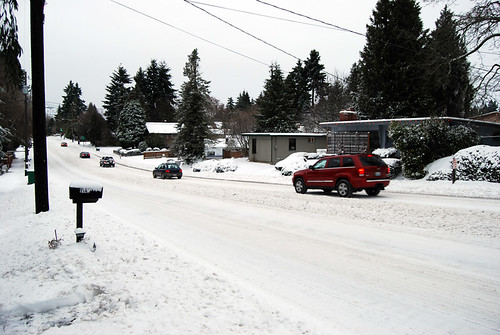
It's handy to have the city's snow plows' home garage just a couple blocks away on the same street. Our street is always the first to get cleared!
We got a touch of freezing rain at the end of the night, making the top layer of the snow very icy. I had to punch the metal ruler through to get measurements. When I dropped the ruler, it clattered on the snow as if I dropped it on a hard floor.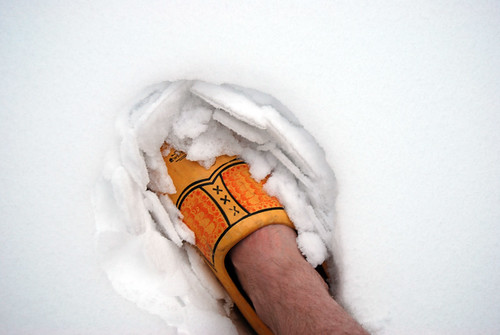
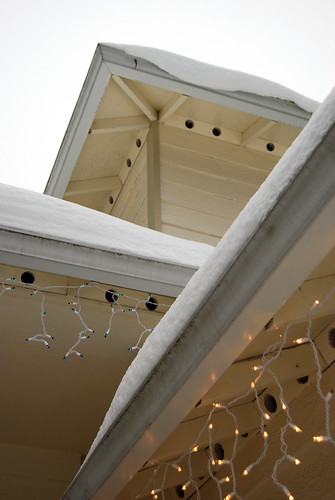
I never finished cleaning the roof before the snow hit a week ago. I wonder how the little clumps of moss are doing, under the snow.
The wind was blowing the tiny snowflakes all over. Christina and I made snow angels in the driveway last night, but the wind nearly filled them in already.
A week ago, Christina made a snowball-sized snowman on the steps to our front yard. Can you find it now?
Even our sheltered front porch got snow blown onto it.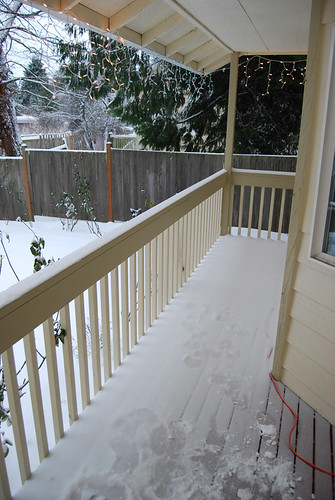
And this was the leeward side of the house. The windward side had three inches piled against the sliding glass door.
Merry Christmas!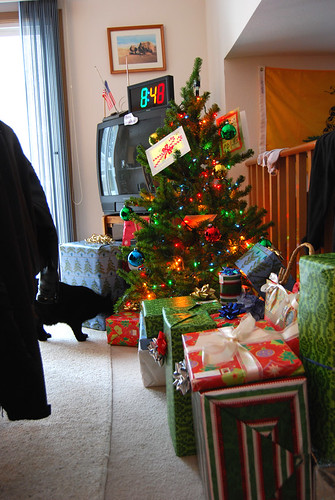
We took my in-laws to lunch yesterday afternoon for a Christmas get-together. My sister-in-law spent an extra hour at her parents' apartment before heading home (after it was already snowing). She left their place at 4:30 and got on I-5. An hour later, she called us and said she was only to the 520 junction. Less than ten miles in that hour. I had hoped she would have left earlier, but . . .

As the world grows dark, we pause now to celebrate the holy day of the God of Death, Pétíso!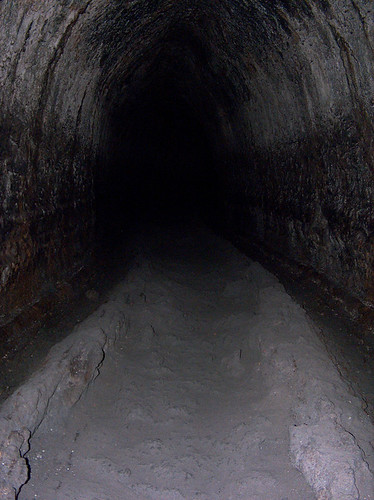
When the gods were young and Pétíso’s father, Korutuzho, God of Agriculture, ruled the universe with capricious and malevolent will, Pétíso and His siblings held a secret meeting. Chief among Them was Sozho, High God of Air, Who was itching to challenge His father and rule the universe Himself. Also there were Nuvíní, High Goddess of Earth; Vasataté, God of Oceans; and Voro, God of Hearth Fire. All had had enough of the rule of the older generation and the evil that Their father had become. Unanimously, They declared war upon Korutuzho.
The young gods and the old gods met on the field of battle. Deftly fighting from His ink-black chariot drawn by four black stallions, Pétíso defeated all the demigods Who came His way, but never was able to corner His father or one of His uncles. The two armies fought to a draw.
Pétíso donned His Helm of Darkness, rendering Him invisible. Since the other gods could still see His chariot racing across the field, He abandoned it and fought on foot. Still, Korutuzho’s demons and demigods blocked Pétíso with their ever-increasing pile of dead bodies. Korutuzho maintained His hold on the Tablet of Destinies, and thus control of the universe.
When night fell, the two armies retired to their camps. With the Helm of Darkness firmly upon His head, Pétíso walked to His father’s camp, invisible to all guards and sentries. Although He could have walked up to Korutuzho and slit His throat, Pétíso instead chose the honorable path and destroyed the weapons of Korutuzho’s army. Tent by tent, Pétíso bent the swords and broke the arrows of every god, demigod, and demon allied with His father.
The next morning, Pétíso and His siblings waited on the battlefield for Their father. Eventually, Korutuzho arrived carrying nothing but the Tablet of Destinies. Knowing that it must have been Pétíso Who conquered Him, Korutuzho began handing the tablet to Pétíso. Sozho, however, lunged forward and snatched the Tablet of Destinies for Himself.
Not wishing to fight His brother so soon after Their joint victory, Pétíso did not challenge Sozho. Instead, He suggested that They decide Who among Them would rule each aspect of the universe. Sozho claimed the air for Himself, since He wanted to be above everyone. Nuvíní claimed the land and all that grows from it. Vasataté claimed the oceans. Voro claimed fire. Lacking anything physical left to rule, Pétíso claimed the souls of all living beings to be His domain.
Dejected and forgotten, Korutuzho left to plant some crops, not realizing that He had had His shoes on the wrong feet all morning.
The five sibling gods each went His or Her own way, exploring Their new territories and asserting Their rule. Pétíso cared for the souls of humanity, demigods, and all. He nurtured them. He answered prayers and became quite popular. Sozho grew jealous.
In a fit of rage, Sozho stabbed Pétíso in the back, straight through His heart. Pétíso died instantly. To hide the body, Sozho stuffed it into a box and sent it floating down the Nízhorosívo River. Thinking His evil deed accomplished, Sozho returned to His home.
Pétíso’s spirit, however, remained. He did not immediately to the afterlife like most souls. Pétíso could not depart, for He had to remain to protect the universe’s souls from the evil of Sozho.
Pétíso awoke his pet dog, Sérasavasé, and sent him tracking His body down the river. The spirit of Pétíso then quickly went to His sister, Nuvíní, and told Her what had happened in a dream.
Nuvíní caught up to Sérasavasé at the banks of the Nízhorosívo River, where She spotted a large wooden box caught by some drooping branches. Nuvíní fished it out and discovered Her brother’s dead body inside. Overcome with grief, for She loved Pétíso dearly, Nuvíní broke into tears, doubling the flow of the river.
Seeing Nuvíní in such pain, Vuzhí, Goddess of Life, took pity on Her and brought Pétíso back to life. Nuvíní thanked Vuzhí and kissed Pétíso, waking Him up. Pétíso welcomed His return to the living, grateful to Vuzhí, Nuvíní, and His dog Sérasavasé.
Pétíso resumed His duties, tending to the souls of the universe, sending Sozho back to the skies. He was wary of His brother, careful that Sozho might try something again. The next time Pétíso was alone, however, Sozho attacked Him.
Pétíso fought gallantly, but Sozho had His impenetrable shield, thus rendering Pétíso’s blows ineffective. Sérasavasé’s teeth and claws were useless against Sozho’s shield, and so Pétíso ordered him away. As Their swordfight drew on, Pétíso succumbed to scratch after scratch, nick after nick, until He had bled so much that He lost strength and collapsed.
Sozho leapt at His brother and sliced off His head. He then proceeded to carve up Pétíso’s body into a pile of bloody bits. He scattered the pieces of Pétíso’s body throughout the world, so that Sérasavasé wouldn’t be able to track Him and Nuvíní and Vuzhí would not be able to revive Him. So Pétíso would never be whole, Sozho took His manhood and fed it to an eagle.
With Pétíso’s spirit helping as best He could, Nuvíní and the dog Sérasavasé tracked down all the pieces of Pétíso’s body. Nuvíní reassembled Him, but much to Her chagrin, one key piece was missing. She sent Sérasavasé out to look for Pétíso’s manhood, but that was a futile mission. Eventually, they gave up. Nuvíní fashioned a manhood out of gold and attached it to Pétíso’s body.
Nuvíní called upon Vuzhí and asked Her to revive Pétíso again. The beautiful, young Goddess of Life sadly informed Her that She could not bring Him to life a second time. She had pushed the balance of nature just to bring Him back once. Vuzhí tried to comfort the grieving Nuvíní, but eventually decided to leave the earth goddess alone with the body.
Nuvíní held Pétíso’s body close to Her and cried. Filled with longing for Her dead brother, She kissed His body all over. She decided it was time to bury Pétíso forever, but the sight of His golden manhood gave Her pause. One last fling would not be impossible; it would be grand to give Pétíso a memorable goodbye.
Pétíso’s spirit had been nearby the whole time, and when He saw what Nuvíní was doing, He re-entered His body to fully experience the sexual delight. Much to His surprise, as They climaxed, Pétíso awoke. They both screamed with pleasure. Falling together, Pétíso whispered thanks into Nuvíní’s ear. The next spring, Nuvíní gave birth to Huro, God of Thunder.
After being dead and resurrected twice, Pétíso had gained insight into all the happenings of the universe, both in the physical and spiritual planes. He was, in a word, omniscient. He set up His home in the underworld, with a great hall constructed where He judges every arriving soul. His dog, Sérasavasé, stands at the gates to the underworld, guarding against any non-departed souls -- especially Sozho -- who might come Pétíso’s way.
Some years later, Pétíso seduced the lovely Vuzhí. They married and She joined Him at His castle in the underworld. Unfortunately, with Vuzhí gone, the world above became cold and lifeless. Pétíso convinced Her to leave Him for half the year and bring life to the world, which is why we have seasons.
Pétíso is all-seeing and all-knowing. If you lead a good life, He will grant you bliss in His presence, to be followed by a return to our world as an enlightened and powerful being. If your soul is fraught with evil, Pétíso will condemn you to infinite pain, followed by a return to our universe as a pillbug or mosquito, to be squished flat as soon as you comprehend your surroundings. The good have nothing to fear from Pétíso. The evil, though, must beware!
We finally got more snow. About 1" when we woke up this morning.
The street wasn't too slippery (and it was empty) so I drove to work. We're back home now, before sunset. We got about 3" accumulation today, so we're certainly not getting dumped on like surrounding areas.
My office view: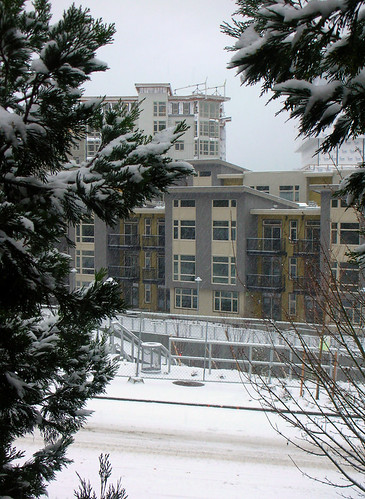
Snow birds: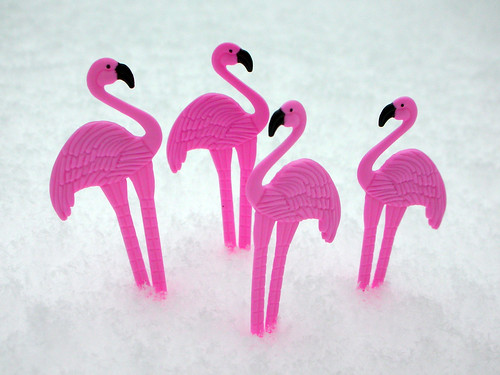
Our backyard: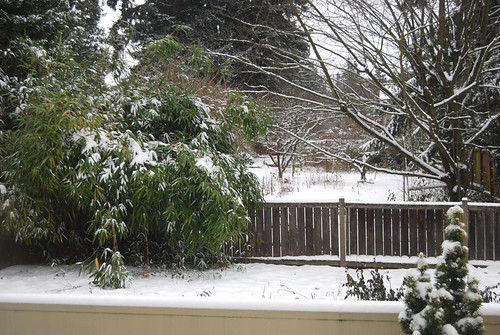
Not too bad, but I didn't want to drive after dark. So here we are. . .
The snow is too fluffy for a snowman, though. Hmph.
The rain/snow accumulation for today:
And Seattle School District had a snow day for this?
My outdoor thermometer measured 16°F at 7 a.m. this morning.
I'm so glad I live in Seattle where we have a warm marine mass to moderate our air temperature!
We finally got our free shipment of snow, fresh from Canada.
Which is really too bad, because I wanted to drive highway 17 this weekend. But no. Winter came two days too early.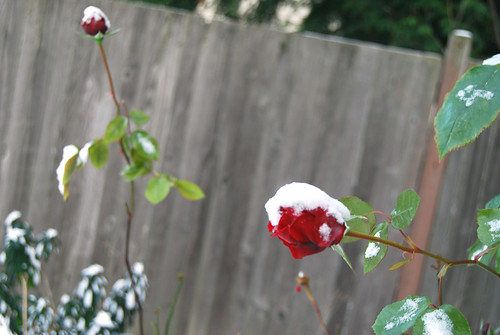
Our roses never know when to quit blooming.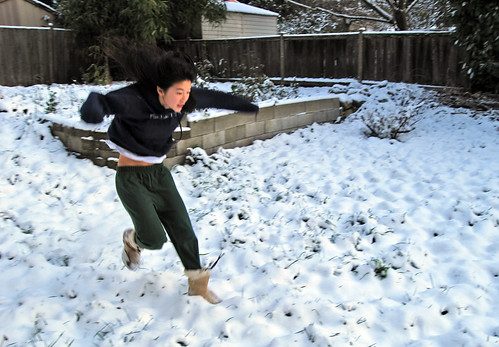
We only got two inches, but that's enough to make Christina run around happy.
I'm sure winter will be over in a couple weeks. We can drive highway 17 then. And go Christmas shopping, too.
After being told that our plans were lost, I got the surveyor to send me a new version. I made copies at Kinko's. Chunlin took them to DPD and was more-or-less rejected.
The original was folded (by the surveyor), which is a big no-no. My Kinko's copies had dark streaks on the edges, which is also not allowed. Finally, the surveys weren't notarized. Somehow, I never knew that I was responsible for getting the surveys notarized.
It's the surveyor's drawing, so shouldn't he do it? No?
So I called the surveyor back and had him make more copies (with original signature), but not fold them. I picked those up on Wednesday, had them notarized yesterday, and we dropped them off at DPD this morning.
Blargh.
And still no word from City Light on rerouting the electrical feed.
Do I seem more annoyed or resigned?
Rice is officially in the Texas Bowl versus Western Michigan, December 30.
The Texas Bowl wanted to get Notre Dame, but they went to the Hawaii Bowl. Bah. Now Rice has to play a MAC team.
(I can imagine WMU alumni saying something very similar about this match-up: "WMU to play . . . Rice?? Why do we have to play some small-school C-USA team??")
Back in October, Chunlin dropped off the final survey and other information to the city. Shortly thereafter, the city published a decision that approved the subdivision, conditional on a comment period and submittal of the final survey and other information that Chunlin had dropped off.
I had called the reviewer and she told me that I didn't need to submit anything else. I just had to wait.
The comment period ended November 3. I waited for a final notice. These things take time, right?
I called her today. She says that although the computer shows the final survey is with the plans routing person, that person doesn't have the survey. I called this other woman and she said that even though there's only a couple places where the drawings could possibly be, they're gone. Vanished.
According to them, my only option is to resubmit the final survey. And since it has to be an original version with a signature and I had only kept a copy, I need to get it from the surveyor.
I asked the plans routing woman about a reimbursement from the city for her mistake. She sounded apologetic . . . but no.
In other news, Seattle City Light still hasn't scheduled the electricity cut-over.

Blessed be Hívuítoví! May She cleanse your soul.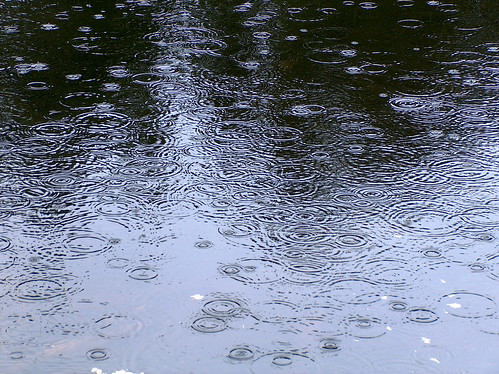
When Zhíanoso, High God of Fire, created the universe, He gave Hívuítoví’s brother Névazhíno, God of Animals, the task of naming and giving traits to all the animals. Névazhíno proudly set about His job, granting love to the deer, anger to the alligator, mischief to the rat, joy to the marmot, fear to the armadillo, and so on. The names were the easy part; He had infinite names to choose from.
Hívuítoví noticed how quickly Her brother was going through the traits. He didn’t have an unlimited supply of those. She cautioned Névazhíno to be careful not to run out before His task was completed. Névazhíno chuckled at His sister’s comment and went about His business, happy as can be. When He got to the last animal, the man, Névazhíno suddenly realized that He had no traits remaining.
Disappointed, Névazhíno shrugged and walked away. From a distance, Hívuítoví watched the solitary, traitless man. The man, whose name was Sétané, sat on the ground with his arms around his knees, shivering slightly, staring at his feet.
Hívuítoví didn’t know what to do. She wanted to make up for Her brother’s mistake, but Her exceptional skill of bringing rain to fertilize the land wouldn’t help Sétané. She watered the plants so he would not go hungry, but he remained a cold, lonely man even after eating. To top it off, Sétané injured himself while picking apples. Hívuítoví could hear Sétané calling out with his soul, praying for assistance while he sat bleeding from the gaping wound in his leg.
Since Sétané was Zhíanoso’s creation, Sozho, High God of Air, decreed that no god should help him. Zhíanoso was too busy observing His creation to actually get involved. The other gods and goddesses all obeyed Sozho, the King of the Gods.
Hívuítoví, however, couldn’t live with Herself if She did not help Sétané. She heeded his prayer and went to his aid. She healed his injury; She cleansed his soul, making him more sanguine about his situation; but She could not warm him or give him any distinguishing trait.
Hívuítoví decided that Sétané needed fire, to warm him, so She tracked down Zhíanoso and asked Him for some fire. Zhíanoso liked Hívuítoví quite well, and also felt attached to His creation, so He gave the goddess a small horn with a few burning embers inside.
Knowing that Sozho would try to stop Her, Hívuítoví raced back to Sétané and gave him the embers. Sétané thanked Her for the embers and promptly started a fire with collected reeds and branches. The fire not only warmed Sétané’s body, but also his soul. Watching the dancing flames, Sétané started tapping his fingers in a rhythm and then began swaying to his first taste of music. In a few days, he also began cooking his food and constructing a shelter for himself, thanking Hívuítoví all the while.
The King of the Gods was not so pleased as Sétané. Sozho swept down upon Hívuítoví, appearing out His thin air to capture Her and bind Her with thick chains. Hívuítoví did not bother to ask His reasoning, for She knew quite well. She had disobeyed His order to not help the man.
Sozho chained Hívuítoví to a giant boulder and set about an eagle to peck out Her liver every day, which would regrow every night. He declared that this would be Her punishment for all eternity and that no god shall help Her, or else He too would suffer the same fate.
The eagle began eating Hívuítoví’s liver. She screamed out in agony, despite Her attempts to remain calm. Through the excruciating pain, Hívuítoví realized that no one would dare cross Sozho. This would be Her fate until the end of time.
Days disappeared in a haze for Hívuítoví, lost in a blur of misery.
Suddenly, the eagle flew away, chased off by someone. Hívuítoví focused Her eyes on the figure before Her, seeing that this person had the torso of a god and the hindquarters of a horse. As Her chains were broken, Hívuítoví recognized Him as Karané, demigod son of Korutuzho. Karané was a great archer and healer, having taught both arts to many gods, including Sozho. Karané mended Her liver, sealing up Her side, and then urged Her to leave quickly.
They both fled from the boulder, but not before Sozho spotted Them. He jumped in attack, swinging His sword at Hívuítoví with a bellow of rage. Even though Karané did not have a sword, He stepped in to block with His bow. Sozho’s sword shattered Karané’s bow and cut straight through the demigod’s side, killing Him instantly.
Filled with anguish for having killed His mentor, Sozho forgot about chasing Hívuítoví. He took Karané’s body up into the heavens and placed Him in the night sky as the constellation, the Archer. All the gods took a fourday of mourning for Karané’s passing.
Soon thereafter, Hívuítoví married Zhíanoso. For a wedding present, Hívuítoví asked Her new husband to give the solitary man a wife, as well. Zhíanoso agreed. He put Sétané into a deep sleep and excised a rib from the man, from which He created the first woman. Hívuítoví’s brother Névazhíno named her Vétaurosí.
Sétané awoke to see Vétaurosí, who greeted him fondly. Hívuítoví blessed their wedlock and they consummated their union. Vétaurosí bore several children, thus creating the human race.
As a wedding gift, Hívo, God of Clean Water, gave the first humans a small, sealed clay jar, instructing them to never open it. Névazhíno told them to go ahead and open it, since what use is a sealed jar? Hívuítoví, on the other hand, warned the humans to heed Hívo’s warning. The water god must have good reason for telling them to keep it closed.
It seemed as if Sétané and Vétaurosí listened to Hívuítoví, so She returned home with Zhíanoso. Névazhíno, however, wanted to see what was in the clay jar, so He transformed Himself into a snake to approach the humans again. By portraying Himself as a second person arguing for opening the jar, Névazhíno convinced Vétaurosí to break the seal.
The instant the jar opened, a swirl of evil erupted into the world. Hate, jealousy, pride, shame, greed, laziness, and gluttony flowed from the tiny jar, infecting the humans and their offspring. Until that time, the humans had walked naked, but with shame, they hastily affixed leaves to their bodies. When Zhíanoso accepted Sétané and Vétaurosí’s second son’s offering before their eldest son’s sacrifice, the eldest became enraged and murdered his brother. Evil permeated all.
At the bottom of the jar, nearly crushed to extinction by the weight of the evil, lay a weak wisp of hope. Hívuítoví coaxed the hope from the jar, breathed fresh life into it, and set it aflight into the world to counter the evil. To this day, Hívuítoví traverses the world, renewing hope wherever evil seems to have overcome it.
It is from Hívuítoví’s cleansing rain that evil is washed from our souls. It is from Hívuítoví’s cleansing rain that the land and women are made fertile. It is from Hívuítoví’s example that we learn to plan ahead and heed warnings. It is from Hívuítoví’s example that we learn to care for others, despite evil directives to the contrary.
So, pray to Hívuítoví! Pray to Her for the well-being of your soul. Pray to Her for hope and the conquering of evil. Pray to Hívuítoví, and She shall wash you clean.
Sotosoroto Husband, author, architect, king-abdicate, etc. etc. etc. |

|
California Roadtrip, Summer 2006

Light Rail Neighborhood Density
The World Does Not Agree with You
Failure Should Never Be Rewarded
Thoughts on Illegal Immigration
I'm a Native American, Dammit!
More "Global Warming" Skepticism
Giant Solar System Model along I-90
Restaurant at the End of the Universe Movie Idea